
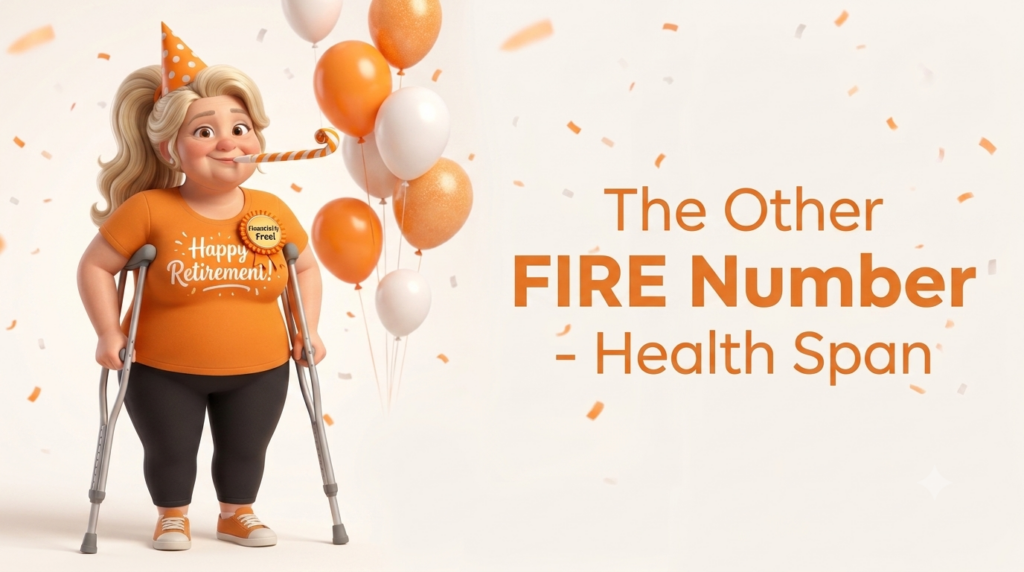
Everyone is obsessed with their net worth target. Or if they have picked the right Safe Withdrawal Rate. Minimised portfolio fees. All the usual good stuff. But what about the other FIRE number that matters just as much? What’s your likely healthspan?
But what about the other FIRE number? The one one that will have just as much impact on how much you enjoy your retirement, early or not.
Yes, I’m talking about your own personal Healthspan. And it’s not looking pretty if you’re in the UK….
Are We Playing The Wrong Game - Healthspan Vs Lifespan
No, I’m not talking football – though England are still making a go of it as I type this. I’m talking healthspan.
As I look at my own journey—having stepped off the corporate treadmill at 43 and recently crossed that major milestone of turning 50—I’ve realized there is a bit of an oddity in the financial independence (FIRE) community. So much is written about sorting out our finances and you will find plenty of debate and hand-wringing on planning for old age and care needs. But there’s very little about optimising our own biological machinery.
What is the point of winning the financial freedom game if your body decides to retire a decade before your money does?
True early retirement isn’t just about buying back your time. It’s about having the physical capacity, vitality, and energy to actually live it.
And if you are planning your future inside the UK, there is something disturbing brewing that I find odd isn’t discussed more. It is the widening chasm between lifespan (how long you live) and healthspan (how long you live free from chronic disease and debilitating decline).
The Number Nobody Wants To Talk ABout
Life expectancy is the number everyone quotes. Health span – the years you actually spend in decent health, not just alive – is the one that matters and the one almost nobody talks about.
And on that measure, the UK is not doing well. Not “could try harder” not doing well. Proper, structural, fallen-down-the-league-table not doing well.
According to WHO data, of 21 high-income countries tracked between 2011 and 2021, the UK is one of only five where healthy life expectancy actually went backwards, and it had the second steepest decline of the lot. You can see the whole HALE (Healthy Life Expectancy) story on their website but this is a snapshot:
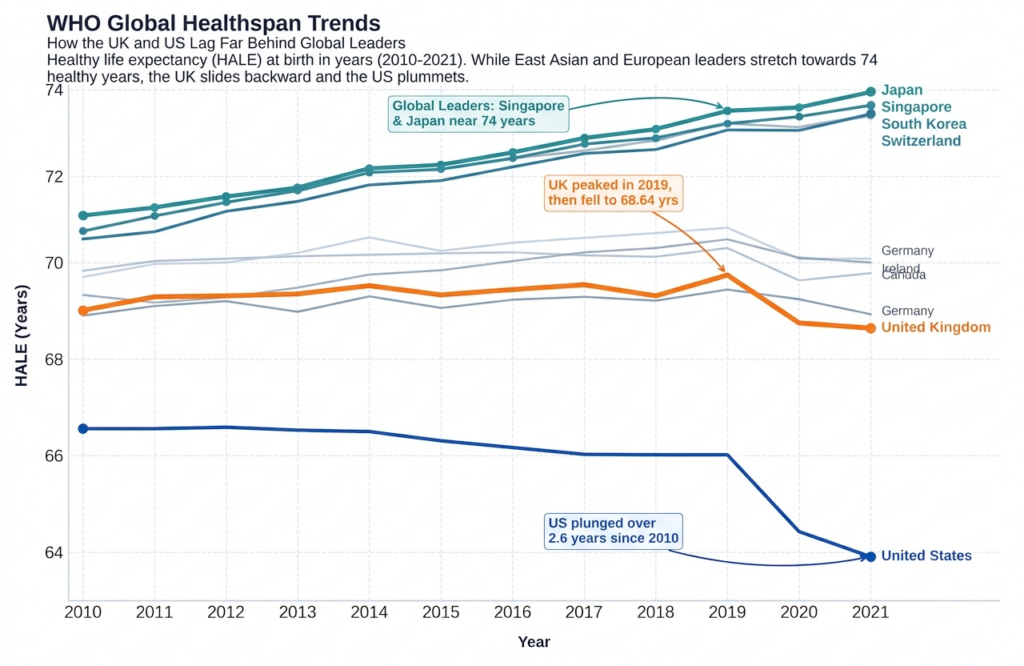
Only the US now ranks below us in terms of comparable economies. Make of that what you will – but I’m not convinced it’s exactly celebrating territory.
But the WHO data is, well, dated, only running up to 2021. So we have to turn to our own trusted ONS for the latest UK picture. It’s not an exact like-for-like in methodology as the WHO, which is a little confusing, but it’s the best that there is.
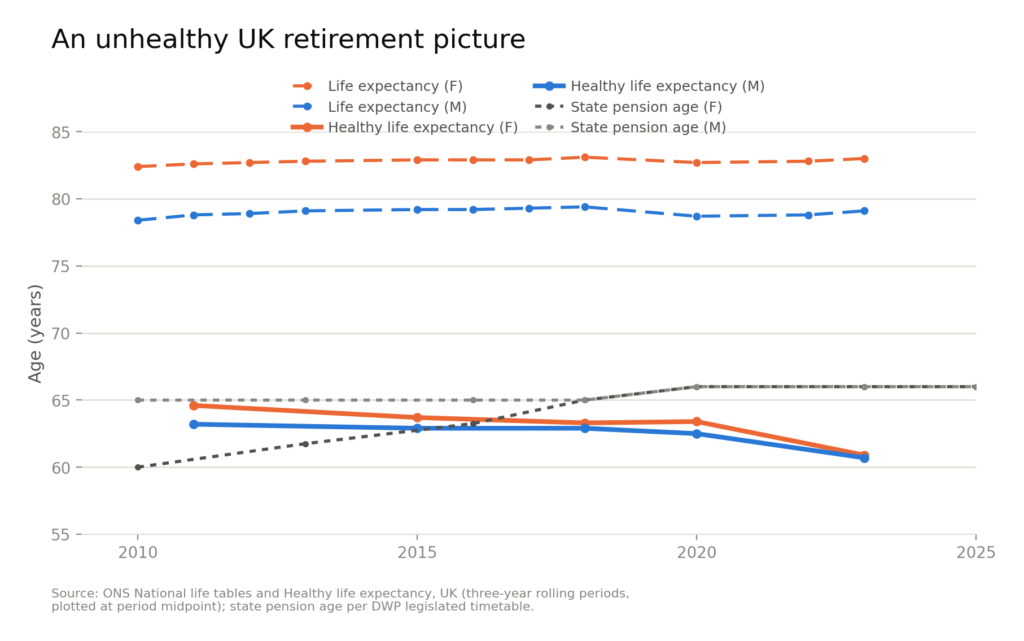
Unfortunately, this shows that it’s not just our relative position that’s slipping, our actual numbers are going backwards in absolute terms too. Both male and female healthspan fell by two years down to just over 60.
This story did get some media attention earlier in the year, largely for highlighting wealth disparity in the UK. I think the problem with using it more widely is just how subjective the measuring can be. It’s often up to individuals to judge if they feel their health is “very good” or “good”. Rather than any objective view on actual disease or ill-health.
But I’m surprised it didn’t make bigger headlines when UK healthspan fell below UK state pension age… Maybe it’s because life expectancy itself has stayed roughly flat/improving over the same period. We’re not dying earlier. We’re just spending more of the life we do have unwell.
But 60? I mean, really? That’s well before the expected state pension age in the UK. Implying that most of us, on average, can expect to be dealing with some level of ill health before we’re even supposed to think about enjoying retirement.
Fortunately, anyone interested in retiring early isn’t your average ‘let’s just wait and see what happens’ kinda guy or gal – right? What happens if you apply the same proactive mindset of fixing your finances to your health? Instead of debating the “will I live to 90 or 100” conversation for our FIRE spreadsheets (yes, I’m still banging on about that one), the far more useful question is quietly getting ignored: how many of those years will actually be worth having?
Everyone always says ‘there’s nothing better to spend money on than your health’ – but what does that actually look like?
Getting Ahead Of The Game
No, not more football puns. But a look into where does someone more proactively inclined actually start? The NHS is what it is, a genuinely remarkable thing for being free at the point of use healthcare for an entire population. I’ve travelled in enough places to know that it’s better than a lot of other solutions.
But it’s focus, understandably, is to treat things once they’ve already gone wrong. Symptoms first, investigation second, treatment third. It’s a system optimised to catch you when you fall. I’ve had the unfortunate experience of seeing it in action first-hand. It’s actually pretty good at that job, especially the acute stuff. It was simply never designed to stop you falling in the first place, because that was never really its purpose.
You can see the effort going in to change that now – even to the extent of bribing, sorry, I mean rewarding, people to manage a 30-min walk a day!
My point is that I’ve got a different purpose in mind, and there’s little support for it anywhere in the system.
The NHS conversation around “prevention” and “healthy life” mostly boils down to five things – eat better, sleep more, drink less, move more, don’t smoke. All true. All useful.
But us FIRE folk don’t want to just stick at the obvious! We can improve on that! After all, if we can spend hours chasing down portfolio fees, surely I can fine tune improving my health!
After all, the general health advice is a very blunt instrument if what you actually want is a personalised, proactive view of your own risks, years before anything shows up as a symptom worth a GP appointment.
That gap between “public health for everyone” and “my own health, personalised, starting now” is exactly where I think the interesting opportunity sits in addressing ‘the other FIRE number’ of healthspan.
But what do folk actually do? What’s available?
Hedging for Disaster vs. Investing in the Asset
And so I went digging. Just like when learning about what it would take to retire early,looking up and down all kinds of weird rabbit holes as to what people actually did when it came to looking after their health beyond the obvious.
People with money, science bods, researchers, athletes. You name it, you can read about it. Fascinating stuff.
And the result? If you go looking for how to spend money on your health in the UK, proactively is….?
Insurance. Endless insurance. Private medical cover so you can skip the queue once something’s already wrong. Critical illness cover paying out once you’re already ill. Life insurance paying out once you’re already dead. It’s all built around the same idea – cover the cost of the thing going wrong, or the cost of your absence once it has.
What you will not find much of, until you start going down those rabbit-holes, is a market for spending money to find out what’s going wrong or is likely to be an issue before it’s a problem. But it does exist.
There’s a slim but genuinely growing corner of this – full body MRI scans, biomarker blood panels, genome and polygenic risk testing – but it sits off to the side as a niche, expensive extra. Not something sitting next to your ISA and your pension on the “sensible things to do with your money” list.
The supplements market is further advanced. Protein targets above the ‘staying alive’ bare minimum levels is finally catching on – and it’s all over the supermarkets now. No longer a bodybuilding niche. But it’s still tiny relative to how much we spend on insuring against illness rather than trying to avoid or – or at least catch it early.
Getting Ahead Of The Health Curve
I think one reason is that it’s hard to figure out what’s good, what’s marketing hype and what’s just wrong. Official health advice is often slow to catch up and often demands level of proof that quite frankly won’t exist as there’s not enough money in it to pay for the research required.
Hence there’s an opportunity – or requirement – to take on the research task yourself, not unlike investing for early retirement. After all, we’ll happily endlessly debate over the ‘right’ portfolio mix and obsess over 0.1% in platform fees. But ask most people what their actual biomarkers look like, or whether there’s anything worth catching early hiding in their genes, and it’s a blank stare. People chasing FIRE often manage financial risk like professionals and health risk like it’s someone else’s job.
Which is just a bit odd when your health is going to have just as much impact on how great or not your retirement, early or not, is going to be.
I think it suffers from some of the same issues as tackling retirement funding – figuring out what’s genuinely useful, solid advice from all the hype is not exactly a trivial task. Not everything in this space is worth your money yet. There’s a genuinely useful ongoing debate in the genetics community about how much a lot of consumer genetic risk scoring actually changes anything, versus just telling you your lifetime risk of something common moved from 11% to 12%, with no actionable follow-up attached. So this isn’t a case of “just buy every test going.” It’s a case of the market for genuinely useful, actionable, proactive health information being far smaller and less developed than it should be, when set against how enormous the market for reactive insurance is.
Perhaps it’s the active equivalent of investing? After all, most people are just fine with the standard advice. But if you’re looking for that little bit more, then there’s some genuinely interesting avenues opening up rapidly.
A Health Portfolio?
Money spent on genuinely proactive health information, decent bloodwork, a scan, understanding your own risk factors, isn’t a luxury purchase or health anxiety dressed up in a nice branded box.
It’s the same logic as an emergency fund. You’re not paying for treatment. You’re paying for information early enough to actually act on it, and then acting on it, rather than collecting data for its own sake.
Because here’s the maths that should worry every early retiree far more than any market crash ever will. It doesn’t matter how carefully you’ve built your number if you don’t have the health span left to spend it.
All that FIRE planning, the spreadsheets, the safe withdrawal rates, it’s all built on an assumption that you’ll be well enough to actually use the time you’ve bought yourself.
Maybe it’s about time we started planning just as hard for what shape we’re in when we get there. Though remember to get off the sofa away from the spreadsheets for a walk…
If anyone has any particulr interesting or useful rabbit holes you think I’d enjoy learning about – happy to hear them!
And for all those confused by the blog post release on Monday – it’s just been that long since I posted I forgot I shouldn’t press that button until I’ve actually finished……..sorry!



Hey, good to see you back, Michelle! Seems I missed your five-oh post so will have to catch up there!
Keeping fit and healthy has always been part of my FIRE plan; what’s the point of retiring early if you’re not well enough to enjoy it?
I’m a fan of moderation, a bit of anything isn’t going to hurt me for now, so I eat and drink a bit of everything. Many of my beer-swilling friends from uni days are now teetotal for health reasons, I seem to be one of a dying breed.
My experience of the NHS hasn’t been too bad – anytime they offer me a free health check or scan, I’m up for it, be it mammogram or colon cancer check – best to be safe than sorry. I pay for an annual cholesterol test for my own piece of mind.
These past couple of years I’ve been more acutely aware of my ageing body and its limitations – I’ve been doing weight-training since my early 40s but am not being able to lift some weights I used to, have reduced flexibility, aching/creaky joints, longer recovery periods needed.
I probably need to review all, so this is a timely reminder that I could do a bit more!
Hey Weenie! Nice to hear from you! Ha – no worries – I’m not exactly posting on a regular schedule – I have no idea how you manage it!
Agreed, I make sure to do the tests the NHS offer. I know they’re not all exactly pleasant ( the poo stick experience was an interesting new one 🤣 ) but I think it’s important to be responsible for your own health and at least try your best.
I’m only now getting into the weights, a bit late to that party. But I’m enjoying it and hoping to progress reasonably fast. I do mix it up with yoga and cycling – as you say – everything in balance!
Thanks for dropping by 🙂
I recommend the book “Built to move” by Kelly and Juliet Starrett. The advice “exercise/move more” is incredibly blunt. This book gives you a bit more about what good movement and physical capability looks like. All exercise is certainly not equal
Thanks Jason, I shall add it to the list to look up. I’m recently learning about weight-lifting/resistance training and it’s been interesting on the difference to cardio etc. I always prefer blunt!
I recommend the book, Younger Next Year, for its practical advice on exercise, health, and staying active that can add both years to your life and life to your years. It’s very engaging in its writing and I found it compelling.
Thanks Peter. I like that, years to your life and life to your years – no point simply having more years if you don’t enjoy them! Cheers for taking the time to read & comment.
Nice post. What proactive things do you find were worth the investment?
Hey. Glad you enjoyed. So far it’s been some of the basic blood tests, stuff that you can’t tell without testing but that you can help fix with diet/exercise etc. Getting some decent weights alongside cardio. Sorting out a basic so-called ‘stack’ of what I don’t reliably get from my diet. All seems to be helping, hence curious about what else you can do with the benefit of access to a lot more knowledge these days.
People in general are afraid to talk about money or death. As if avoiding the discussion will save them. We are not immortal, so all we can do is slow down the irreversible decline as much as possible. I do not claim that what I tested and worked for me is valid or possible for others. But two things have had a clear effect for me and I recommend them: limiting stress and practicing discipline (and its corollary).
Our advanced monkey brain is relaxed when it is in its comfort zone, that is, when it does repetitive, already tested things. Discipline helps here, as a daily routine in processes or order in objects.
Stress reduction is also given by simplicity. Example: I have not owned a TV set for 17 years. Of course, I watch whatever I want, when I want on the internet, without unsolicited advertisements, etc. I am not bombarded with negative news about war, accidents, cataclysms, the stupidities of world leaders.
I do not have an account on social platforms: Facebook, Instagram, etc. Email and mobile phone (rarely on WhatsApp) is enough for friends. Even international.
I could go on, but I don’t intend to make a list of good-natural things. Like celebrating events (Easter, Christmas) when some unknown people in history decided. If you see the world through rose-colored glasses, Christmas is every day.
When the English are asked “How are you?” they modestly reply with “Not so bad” [as you expect me to be]. Instead I answer them with a smile: “Excellent as usual”. Shame makes you a victim.
Thanks John, love the thoughtfulness. Likewise, it’s been ages since we’ve watched “TV”. The idea of seeing ads feels practically foreign now despite being absolutely the norm when growing up. I do think it helps for sure. I get that same sense of peace when travelling and I don’t understand the language well enough. It’s surprising how calming it can be.
The stress thing I personally think is a bit of a double-edged sword. Too little stress and we become less able to handle it. Our brains may thrive in their comfort zones but it’s also helpful for keeping them alert to occasionally force them to cope with new situations. The most mentally alert ‘old’ people I know are those that have a varied life with a lot of input.
Carry on being excellent! Thanks again for taking the time. Appreciate the encouragement!
Very good points – if scary! If your rabbit-holes help you come up with useful things, that would be interesting to know 😀
Thanks Catherine! I shall keep burrowing – who knows what I will unearth next!